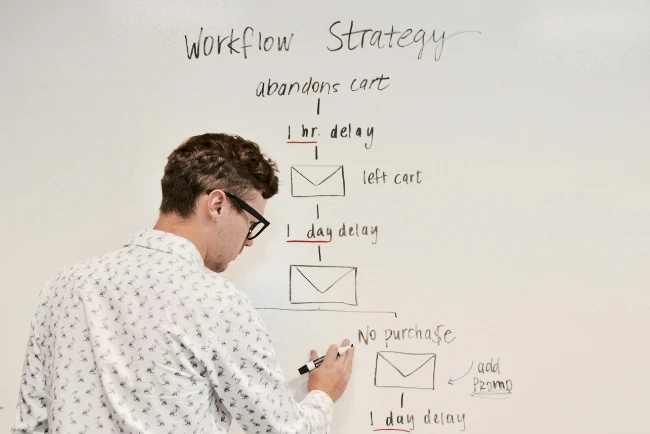
Workflow automation for UK SMEs: a practical explanation
Workflow automation has moved from optional to essential for SMEs trying to scale without constantly adding headcount, and the distinction matters more than most firms realise. This is not about speeding up isolated tasks. It is about orchestrating how work moves across people and systems, how decisions flow from one step to the next, how the entire operation breathes.
In the UK, where productivity gaps persist and smaller firms face relentless pressure to do more with existing teams, that difference is everything.
The Office for National Statistics shows persistent productivity gaps across UK businesses, with large differences between top-performing firms and the median. Research from the Department for Science, Innovation and Technology points to technology adoption, including automation, as one of the clearest levers available to close that gap, particularly for SMEs. The Enterprise Research Centre, meanwhile, notes something quietly devastating: while the number of SMEs has grown, fewer are increasing employment.
Growth without hiring. Efficiency without choice.
Adoption is uneven, many initiatives underperform, and tool-led automation often creates new friction where it promised to remove old friction. This article focuses on workflow automation as a people-first, process-led discipline, grounded in evidence rather than hype, in what actually works rather than what sounds good in a pitch deck.
What is workflow automation?
Workflow automation is the technology-enabled orchestration of multi-step business processes using predefined rules and logic to reduce manual intervention, and rather than automating a single action, it coordinates how tasks, data, and decisions move from one step to the next across a process.
IBM defines workflow automation as the automation of activities that make up a business process, using business rules to route work through each stage with reduced human input. Industry analysts have expanded this to emphasise orchestration across systems, teams, and technologies, not isolated task execution.
Most automated workflows rely on a simple "when–do" logic model. Triggers, such as a form submission or incoming document. Rules, which determine how the workflow behaves. Conditions, which must be met before actions occur. Actions, such as notifications, record updates, or document generation. This structure allows workflows to operate consistently once designed, shifting effort from manual coordination to upfront process clarity, and as Zapier's overview of workflow logic explains, the value comes from connecting steps into a single flow rather than automating them in isolation.

Workflow automation vs RPA and task automation
Confusion between workflow automation and task automation is one of the most common reasons initiatives fall short, one of the clearest signals that someone has bought a tool without understanding the work underneath it.
Robotic Process Automation, or RPA, is designed to mimic human actions at the task level. Copying data between systems. Clicking through interfaces. Filling in fields. Workflow automation operates at a different layer, coordinating end-to-end processes, often combining multiple tasks, decision points, and systems into a single flow.
For SMEs, the risk is mistaking task automation for transformation. Automating a few steps without redesigning the process underneath often leads to brittle workflows, duplicated effort, and manual workarounds, sometimes described as "human middleware", which is to say: people spending their days doing what the systems should have been designed to do in the first place.
Document workflow automation and why it matters
Document workflow automation is a specific subset of workflow automation focused on how documents are created, routed, approved, stored, and audited, and this includes both digital and digitised paper records, which for many SMEs means most of the operational memory of the business.
Pega describes document workflow automation as the automation of document-centric processes such as approvals, indexing, and routing, often with built-in compliance support. Common SME use cases include invoice processing, contract approvals, HR documentation, and regulatory records. The benefits are typically tied to clear audit trails and version control, reduced manual handling and re-keying, more consistent routing and approval logic.
However, applying automation to poorly designed document flows can entrench inefficiency rather than remove it. Standards such as ISO 9001 and ISO/IEC 27001, referenced by the British Standards Institution, emphasise consistency, validation, and information security, all of which rely on sound process design before automation is introduced.
The UK SME context: productivity, adoption, and regulation
SMEs make up approximately 99.9% of UK businesses, employ around 60 percent of the private sector workforce, and generate roughly half of private sector turnover, according to the Federation of Small Businesses. Despite this scale, productivity varies widely, and the variation tells us something uncomfortable about how technology actually diffuses through an economy.
ONS data shows that firms at the top end of the productivity distribution produce multiple times the output of median firms, highlighting uneven diffusion of technology and process maturity. Research from the British Chambers of Commerce indicates that while AI and automation adoption among SMEs is rising, usage remains shallow in many sectors, with most firms automating to a limited extent.
The CBI estimates that wider adoption of readily available digital technologies could unlock tens of billions of pounds in additional gross value added by 2030, with automation contributing a measurable uplift in productivity. These projections reinforce the potential, but also underline that outcomes depend entirely on how automation is applied, not simply that it is applied.
Automated decision-making and data regulation
Workflow automation increasingly overlaps with automated decision-making, particularly in areas like finance, HR, and recruitment, which is to say in places where decisions about people's livelihoods and opportunities get made.
In 2025, the UK introduced the Data (Use and Access) Act, updating the regulatory framework for automated decision-making. Analysis from Debevoise explains that, for non-special category data, automated decision-making is now generally permitted provided appropriate safeguards are in place. This represents a shift from the previous default position under UK GDPR, which was more restrictive.
Importantly, guidance from the Information Commissioner's Office makes clear that "meaningful human involvement" remains a requirement where decisions have legal or similarly significant effects. For SMEs, this means automated workflows must be designed to allow human review and intervention, particularly in regulated contexts. Law firm briefings emphasise that legitimate interests can be a lawful basis, but only when transparency and safeguards are maintained, which is another way of saying: you cannot hide behind the algorithm.
Where workflow automation delivers value in practice
Evidence from multiple sources shows that workflow automation delivers the most value in functions with high volumes of structured, repeatable work, the kind of work that drains energy without requiring judgment, the kind of work people describe as "busywork" because it keeps them busy without moving anything forward.
In finance, research cited by Approveit suggests that a large proportion of transactional activities, including invoice processing and expense approvals, are suitable for automation, with reported reductions in processing time and error rates when implemented well. UK-focused examples from Berks Technologies describe similar use cases across finance, HR, and sales operations.
In HR, TalentHR data indicates that onboarding, leave management, and compliance tracking are common candidates, with automation reducing administrative effort and improving consistency. In sales and operations, automated lead routing and CRM updates help reduce non-selling time and improve handovers, though conversion improvements vary by context and must be interpreted cautiously, which is to say: the tool alone will not close deals.
These outcomes are best treated as ranges rather than guarantees, influenced by process quality, data structure, and adoption.
 How to decide what to automate first
Not every process is a good candidate for automation, and knowing which processes to leave alone is often more valuable than knowing which to automate.
Research on cognitive complexity matrices suggests prioritising processes that are rule-based, data-driven, and prone to human error. Guidance from Growth Process Automation recommends assessing factors such as degree of rule-based logic, structure and quality of underlying data, frequency of manual monitoring or rework, and operational risk if errors occur.
McKinsey and Deloitte framework comparisons emphasise that processes scoring poorly on these criteria often need redesign before automation can deliver value. Attempting to automate around complexity usually increases friction rather than removing it, codifying confusion rather than resolving it.
Why workflow automation often fails
Despite its potential, workflow automation has a high rate of underperformance, and the reasons are rarely about the technology itself.
Statistics compiled by Kissflow suggest that a majority of initiatives fail to meet their original objectives. Common causes include lack of a clear, end-to-end strategy, integration issues between systems, underestimating implementation effort, and resistance to change from teams, which is often less about resistance and more about exhaustion, about being asked to adopt yet another system that promises to make everything easier while making everything, for the first six months at least, considerably harder.
Several analyses describe the problem of "human middleware," where employees manually bridge gaps between poorly integrated systems, and "automation debt," where tactical fixes harden into long-term constraints. These issues are organisational as much as technical, which means they cannot be solved by buying better software.
What a realistic, people-first approach looks like
Evidence from change management frameworks suggests that successful automation starts with process audits rather than tool selection, with understanding the work before attempting to change it.
Combining analytical diagnosis with people-focused models helps address both system design and adoption challenges. Standards from the British Standards Institution, including ISO 9001 and ISO/IEC 27001, provide a governance backbone for consistent and secure workflows. McKinsey's research on AI and automation reinforces the importance of scaling incrementally, reviewing outcomes, and maintaining human oversight as systems evolve, which is another way of saying: move slowly enough to learn from what breaks.
Clarity before automation
Workflow automation is an architectural choice, not a shortcut, not a way to avoid thinking about how the work actually happens.
For UK SMEs, the strongest results come when automation supports how people actually work, rather than forcing teams to adapt to tools. The evidence points to a simple conclusion, one that sounds obvious until you watch how most automation projects unfold. Sustainable gains come from clarity in process design, realistic expectations about adoption, and disciplined governance. Automation amplifies what is already there. Without clarity, it amplifies friction instead.
If you're ready to bring clarity to your operations and explore how automation can support your team rather than complicate things, we're here to help.